
Mia Friedrich · 20 September 2026
Navigating Data Migration Challenges When Scaling Note Apps Across Regions
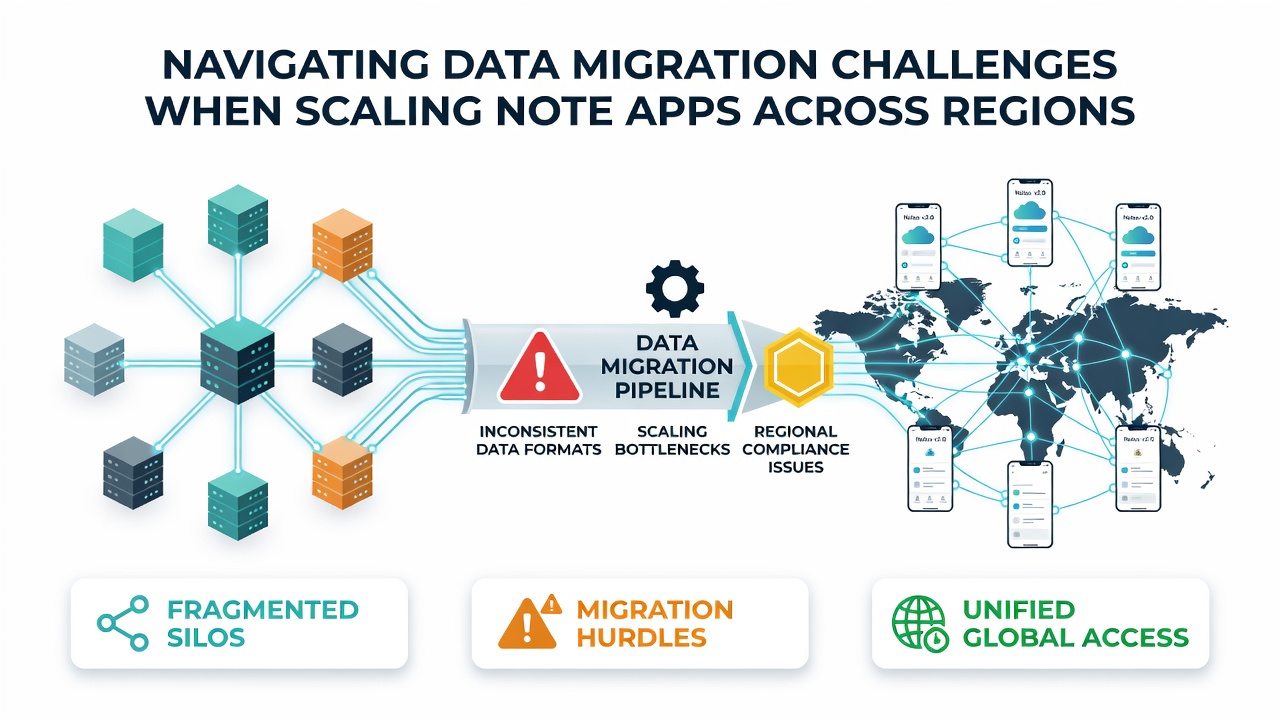
Scaling note-taking applications across multiple regions requires careful handling of data migration processes that move user information between servers and compliance frameworks while maintaining service continuity. Companies expanding operations encounter varying legal requirements that dictate how personal data gets stored, transferred, and protected in each jurisdiction.
Regulatory Frameworks Shaping Migration Strategies
Regional data protection laws create distinct obligations that developers must address during cross-border transfers. The European Union's General Data Protection Regulation establishes strict rules on data movement outside the bloc, requiring adequacy decisions or approved safeguards before any transfer occurs. Research from the European Commission shows that organizations handling note app data must document transfer mechanisms such as standard contractual clauses or binding corporate rules to avoid enforcement actions.
Meanwhile, data residency mandates in Asia-Pacific markets add further layers of complexity. Regulations scheduled for implementation in September 2026 across several Southeast Asian countries will require local storage of certain user records, forcing note app providers to redesign their infrastructure before expansion. Observers note that these rules often intersect with existing privacy statutes, creating overlapping compliance timelines that teams must navigate simultaneously.
Technical Barriers in Large-Scale Data Transfers
Technical obstacles frequently emerge when migrating structured note data, including metadata, attachments, and version histories, across geographically dispersed data centers. Latency issues arise during synchronization when databases span continents, and teams must implement incremental migration techniques that keep user sessions active throughout the process. One study revealed that note apps handling millions of active accounts often use phased rollouts to minimize downtime, testing subsets of data before full cutover.
Database schema differences between regional systems also demand careful mapping, especially when legacy platforms store information in formats incompatible with newer cloud environments. Engineers address these mismatches through custom ETL pipelines that validate integrity at each stage while preserving encryption keys tied to regional regulations.
Data Sovereignty and Storage Requirements
Data sovereignty rules require that certain categories of information remain within national borders, affecting how note apps architect their backend storage. Canadian privacy legislation under PIPEDA, for instance, permits transfers but mandates accountability measures that follow the data wherever it travels. Those who manage note app infrastructure report that maintaining separate regional clusters helps satisfy these constraints, although it increases operational overhead.
Companies expanding into Australia face additional considerations under the Privacy Act, which includes requirements for notifying users about overseas disclosures. Figures from the Office of the Australian Information Commissioner indicate that organizations must conduct due diligence on recipient jurisdictions before initiating transfers, a step that often delays project schedules during scaling efforts.
Security Protocols During Migration Windows
Encryption standards must remain consistent across regions while allowing for key management systems that comply with local cryptography regulations. Teams frequently deploy hardware security modules in each target region to handle key rotation without exposing sensitive material during transit. What's interesting is how note apps that integrate end-to-end encryption face unique challenges because decrypted access on the server side becomes unavailable, shifting reliance to client-side verification tools.
Monitoring systems track data flows in real time to detect anomalies that might signal breaches or corruption during large transfers. Researchers discovered that combining automated logging with periodic third-party audits provides verifiable records required by multiple regulatory bodies.
Implementation Approaches Observed in Practice
Organizations that successfully scale note apps across regions typically begin with comprehensive data audits that classify records according to sensitivity and applicable laws. They then establish pilot migrations involving limited user cohorts to identify friction points before broader deployment. One case involved a platform that synchronized note metadata first, followed by attachment files, allowing users to access core functionality while bulk transfers completed in the background.
Coordination between legal, engineering, and operations groups ensures that technical decisions align with documented compliance requirements. Data shows that projects incorporating automated compliance checks within migration scripts reduce manual review cycles and accelerate timelines.
Conclusion
Scaling note applications across regions demands coordinated attention to regulatory, technical, and operational factors that govern data movement. Providers that map these requirements early and adopt structured migration frameworks position themselves to handle expansion without compromising data integrity or user access. Continued monitoring of evolving statutes, including those set for September 2026, remains essential for maintaining compliant infrastructure as user bases grow.